


When Rescue No Longer Requires the Search

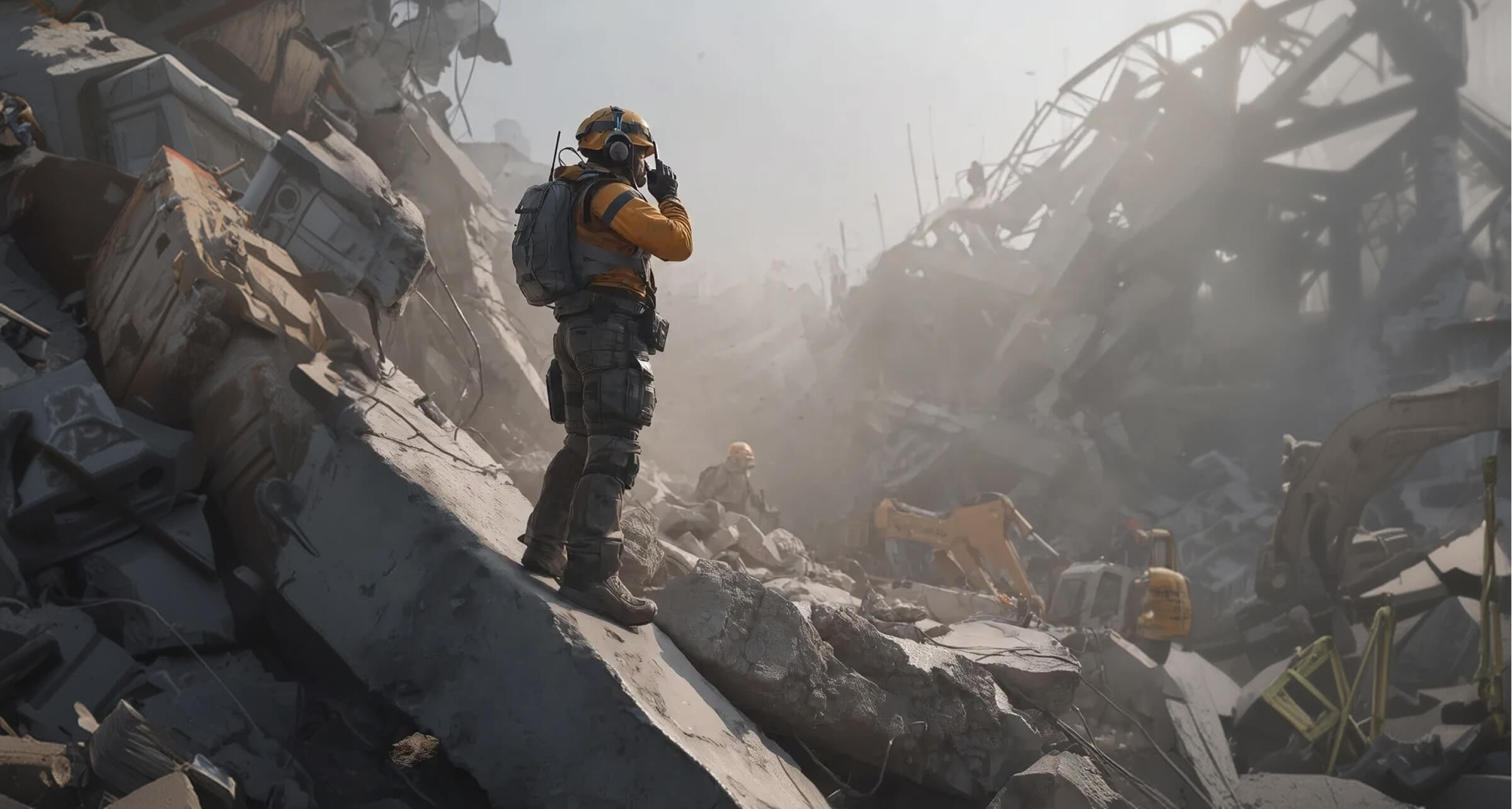
Search and rescue operations rarely take place where communications are easy.
They begin in collapsed neighborhoods after earthquakes, in flooded regions where infrastructure has failed, in dense forests, mountainous terrain, or offshore environments far beyond the reach of terrestrial networks. Responders arrive quickly, but connectivity often does not.
Cellular networks become congested or go offline. Line-of-sight radios are blocked by terrain, debris, or distance. Command centers operate with partial information, while field teams move continuously, often without a reliable link back. In disaster response, this communications gap is both familiar and dangerous.
The Operational Reality of Disaster Response
Modern SAR missions are defined by urgency and uncertainty. Teams are deployed with little preparation time, across large and often hostile environments, and frequently alongside multiple agencies and jurisdictions. Operations unfold simultaneously on the ground, in the air, and at sea.
Yet many communication systems in use today were designed for routine conditions or fixed infrastructure. When disasters strike, those assumptions no longer hold.
Responders are left juggling multiple devices, relaying messages manually, or operating with limited situational awareness - precisely when coordination and speed matter most.
Why Satellite Communications Haven’t Fully Solved the Problem
Satellite communications are often considered the ultimate fallback when infrastructure fails. In practice, traditional SATCOM solutions introduce new constraints.
Many systems are heavy, slow to deploy, or require careful antenna alignment and clear sky visibility. Others perform adequately in static positions but struggle when teams are moving. Configuration complexity and training requirements further limit their usefulness in time-critical missions.
As a result, satellite communications are frequently concentrated at command posts, while frontline teams continue to operate with fragmented or unreliable links.
A Shift Toward Certainty by Design
A different approach is emerging, one that treats connectivity not as a configurable capability, but as an operational certainty.
Commcrete’s SATCOM-on-the-move technology was developed around real-world operational constraints, where planning time is limited, and responders cannot adapt to complex systems. Instead of relying on fragile assumptions, the technology is designed to work immediately, without terrain analysis, infrastructure dependencies, or precise antenna pointing.
The objective is straightforward: ensure continuous connectivity from the moment teams deploy until the mission is complete.
Connecting the Entire SAR Chain
Effective search and rescue depends on seamless coordination between field teams, command and control centers, medical and evacuation units, aerial assets, and maritime responders.
By providing a single, resilient satellite communications layer, Commcrete enables encrypted voice and high-quality data to flow across the entire operation. Teams remain connected while moving. Locations and status updates are shared in real time. SOS alerts and data exchange continue without interruption, even in complex terrain or degraded environments.
This continuity allows decision-makers to allocate resources more effectively, adjust plans in real time, and maintain situational awareness across large and dynamic disaster zones.
Reducing Complexity When Pressure Is Highest
Disaster response leaves no room for cognitive overload. Systems that require constant adjustment or troubleshooting quickly become liabilities.
By eliminating heavy deployments, server dependencies, and weather-related performance degradation, Commcrete reduces the operational burden on responders. The technology integrates with existing radios and workflows, allowing teams to focus on victims and operations rather than on maintaining communications.
Holding Missions Together When It Matters Most
In disaster response, success is rarely defined by a single action. It is the result of sustained coordination under extreme conditions, often over extended periods and across wide areas.
Reliable communication is what holds those efforts together.
As disasters become more complex and response operations more distributed, infrastructure-independent connectivity is no longer a backup option - it is a core requirement. When networks fail and terrain dominates, certainty in communication becomes the difference between coordination and chaos.
Commcrete was built for exactly those moments.