


Tactical SATCOM Toolbox


Commcrete Field Engineering Team
Tactical SATCOM has become a critical infrastructure layer for defense forces, search and rescue teams, and intelligence organizations operating far from terrestrial infrastructure. But even the most advanced system will underperform if the field operator does not understand the fundamentals of satellite communications: line of sight, signal propagation, RF reflections from nearby obstructions, waveform characteristics and link margin.
That gap - between equipment capability and the operator's ability to use it correctly - is often the difference between stable connectivity and precious minutes of lost contact at exactly the moment they matter most.
This article brings together the most practical, foundational rules for correctly operating tactical SATCOM equipment in the field. It is intended for every end user - operator, warfighter, first responder, or commander - working with Commcrete's tactical SATCOM devices or any other SATCOM-on-the-Move system.
Why It Matters: The Physics Doesn't Compromise
Unlike cellular networks, satellite communications depend on a direct line of sight between the antenna and the satellite. Any obstruction between the two - a building, a tree, a human body, a vehicle, even the ground - degrades link quality. The problem is that this degradation isn't always obvious to the operator: an antenna that appears to have "clear sky" can still suffer from RF reflections (multipath) originating from nearby structures or from the ground itself.
That's why, before troubleshooting the equipment, three things should be checked first: antenna placement, the satellite's elevation angle, and distance from obstructions. These are the three variables the field operator directly controls, and they are what actually determine link quality in practice.
On top of user behavior elements, there are two more aspects that will determine communication resilience:
1. Frequency
2. Waveform
Basically, lower frequencies will perform better since penetration is better and signal can come over physical interference with lower degradation. UHF SATCOM is ideal for that use, though it suffers from other deficiencies. L-Band frequencies (approximately X5 higher) will be a suitable alternative offering a sweet spot for tactical users, combining modest signal propagation together with keeping a safe zone from other RF interferences. Radio waveform performance significantly matters also. For this case, Commcrete Stardust and Bittel proprietary waveform will perform 6dB better than other typical waveforms (4 times better) and 16dB better than other poor performance waveforms (40 times better).
But even if user is bound to a specific radio waveform and is using Flipper as a L-band converter only, choosing the right waveform is crucial (ANDVT instead of 16k CVSD in military waveform formats, for example).
What should the user do?
1. Keep the antenna above shoulder height - and ideally above head height
The higher the antenna relative to the operator's body and immediate surroundings, the lower the likelihood that the operator's own body, backpack, weapon, or personal gear will obstruct line of sight to the satellite. Raising the antenna above head height, rather than just above the shoulder, provides meaningfully greater margin - especially at low elevation angles, where any low obstruction has a disproportionate impact on link quality.
2. Stay aware of the satellite link margin for the waveform in use
Every waveform has a different link margin - that is, how much reserve capacity the system has above the minimum threshold required for a functioning link. A waveform with a narrow (low) link margin will require significantly cleaner field conditions than one with a wide (high) link margin. An operator who understands the characteristics of the waveform they're operating on can adjust their field behavior accordingly - for example, applying stricter obstruction-distance requirements when working with a waveform that has a narrower link margin. Commcrete Satlink Master should help typical end users to be aware of the forecasted link margin and maybe even – as much as possible – to help them to influence it by switching to a more suitable waveform that they have in their radio.
3. Know the satellite's position and elevation angle
Before activating the system, the operator should know (or be able to calculate) the azimuth and elevation angle of the satellite relative to the current position. This knowledge allows the operator to deliberately choose orientation and physical positioning for the antenna, rather than relying on trial and error. At low elevation angles in particular, correctly positioning relative to the satellite's direction is the difference between a working link and a complete failure to connect.
4. Maintain safe distance from nearby obstructions - a 1:1 ratio, and 1:2 at low elevation angles
A practical rule of thumb: an obstruction (a structure, a tree, a vehicle, a fence) that is 2 meters tall requires a minimum standoff distance of 2 meters from the antenna, assuming an elevation angle of roughly 45°. At this 1:1 ratio, the line of sight to the satellite clears the obstruction.
At lower elevation angles, the required ratio tightens to 1:2 - meaning a 2-meter obstruction would require a standoff distance of roughly 4 meters or more. The lower the elevation angle, the "flatter" the beam path runs relative to the ground, so any given obstruction affects a wider portion of the line of sight.
This rule is especially important for operators moving through built-up terrain, forested environments, or urban settings - where nearby obstructions are the rule rather than the exception.
What should the user not do?
1. Don't place the antenna inside a closed enclosure
An antenna inside a closed enclosure - a bag, a case, a vehicle compartment - is physically blocked from the satellite, even if the surrounding environment appears open from the outside. A closed enclosure can also cause internal reflections that degrade reception in ways that aren't always obvious to an operator who is only checking connection status.
2. Don't cover the antenna with textile containing non-fabric materials
Pure fabric is relatively transparent to RF signals, but covers that incorporate metal (metallic thread, electrostatic-protective coatings, large metal zippers, certain camouflage netting) or other rigid materials will block or distort the satellite signal. Before using any cover, confirm it is made of "clean" fabric only, with no metallic layers or rigid plastic components.
3. Don't position close to the edge of an existing structure - even if it isn't in the satellite's direction
A common misconception is that only an obstruction directly "between" the antenna and the satellite affects the link. In practice, proximity to a wall or the edge of a structure - even one that does not directly block line of sight - creates RF reflections (multipath) that degrade reception quality and can cause communication errors, slowdowns, or dropouts. As a general rule, maintain standoff distance from structures in all directions, not just the direction facing the satellite.
4. Don't operate with the antenna at ground level
The ground itself - particularly wet ground, vegetation-covered terrain, or any conductive surface - affects RF reflections and degrades link quality, even without any visible obstruction. Operating with the antenna placed directly on the ground (or very close to it) exposes the system to uncontrolled reflections. The antenna should be elevated above ground level as much as possible (a minimum of 1 meter height is fine).
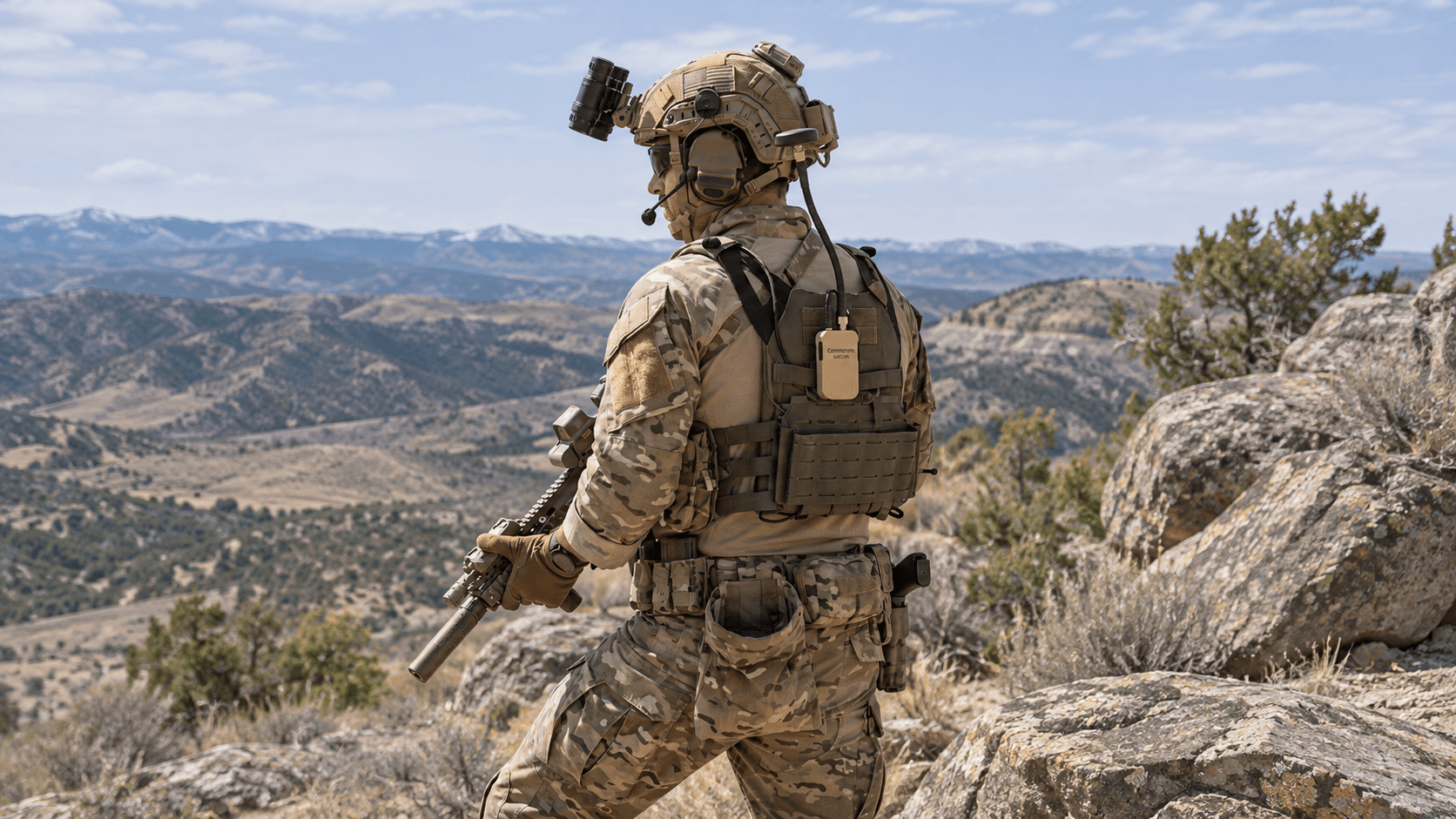
From Theory to the Field: Applying This with Commcrete Equipment
Commcrete's devices - Stardust, Bittel, and Flipper - were designed from the outset to reduce operational sensitivity to these rules: high link budgets, waveforms engineered for resilience under obstruction, and a simple interface that enables fast operation even under pressure. That is why we call it tactical SATCOM; communicate successfully without worrying to adopt yourself to environmental conditions. Even so, there is no substitute for the field operator having a basic understanding of RF fundamentals, practical attitude and some common sense (not too much, though…).
An operator who knows these four DO principles and four DON'T principles - and applies them automatically when positioning the antenna - turns the SATCOM system from "equipment you have to fight with" into a transparent, invisible communications layer, exactly as mission-critical communications are meant to be.
Commcrete develops SATCOM-on-the-Move systems for defense, homeland security, and search and rescue organizations - built to operate independent of ground infrastructure, without requiring precise antenna pointing, and without dependence on weather conditions.